

Digital assets are no longer a fringe topic reserved for technology enthusiasts and cryptocurrency investors. They are steadily becoming part of mainstream financial conversations, prompting finance leaders to evaluate how these emerging technologies could impact treasury operations, cash flow management, and cross-border payments. For Chief Financial Officers, the conversation is shifting away from speculation and towards utility. The real question is no longer whether digital assets exist, but whether they can help businesses operate more efficiently in an increasingly digital economy.
One of the key drivers behind growing corporate interest is settlement speed. Traditional international payments often move through multiple intermediaries, resulting in delays that can affect liquidity and create uncertainty around cash flow. Digital asset infrastructure, particularly stablecoins, offers the potential for near-instant settlement, allowing businesses to move value across borders faster and with greater transparency. This has significant implications for finance teams. Faster settlement can improve working capital management, enhance cash flow visibility, and reduce the operational friction associated with reconciling payments across different markets and financial institutions. In a business environment where timing and liquidity matter, these efficiencies can translate into a meaningful competitive advantage.
However, the opportunity must be balanced with careful consideration of risk. As with any financial innovation, digital assets introduce new regulatory, compliance, security, and governance requirements. CFOs must ensure that any adoption strategy is aligned with applicable regulations, supported by strong internal controls, and integrated into broader financial risk management frameworks. Among the various digital asset categories, stablecoins have emerged as one of the most practical entry points for businesses. Because they are designed to maintain a stable value relative to traditional currencies, they offer many of the efficiency benefits associated with digital assets while reducing the volatility concerns often linked to cryptocurrencies. This makes them particularly relevant for payment, settlement, and treasury-related use cases.
The most effective finance leaders are approaching digital assets with curiosity rather than urgency. They are asking strategic questions about how these technologies can improve operational efficiency, strengthen financial visibility, and support long-term growth objectives. They are also recognising that digital assets should not be viewed as a replacement for traditional financial systems, but as an additional tool that can help businesses navigate an increasingly interconnected global economy.
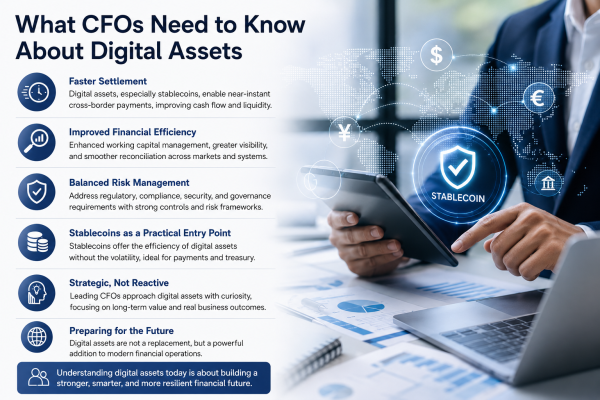
As digital finance continues to evolve, CFOs have an opportunity to move beyond the headlines and focus on practical business outcomes. Understanding digital assets today is not simply about staying informed on the latest trend; it is about preparing for the future of payments, treasury management, and financial operations. At Marasoft, we believe that successful digital transformation begins with informed decision-making. By helping businesses understand emerging payment technologies and their real-world applications, we enable finance leaders to confidently navigate the next era of financial innovation. To find out more about payment, finance, cross-border payment, click here