
The global payments ecosystem is undergoing a structural shift, and it is no longer being driven by technology alone. Geopolitics, once a distant consideration for fintech operators is now a defining force shaping how money moves across borders. Recent tensions, including those involving Iran and the United States, alongside broader global trade and security realignments, are reinforcing a fundamental truth: financial infrastructure is increasingly being used as an instrument of power.
This shift is most visible in the expanding use of sanctions and financial restrictions. Access to global systems such as SWIFT, which connects more than 11,000 financial institutions worldwide, has become conditional rather than guaranteed. Exclusion from such networks can disrupt entire economies, affecting trade flows, liquidity, and currency stability. As a result, compliance is no longer a peripheral obligation for financial institutions and fintechs; it is becoming embedded into the core architecture of payment systems, requiring real-time monitoring, adaptive controls, and significantly higher operational sophistication.
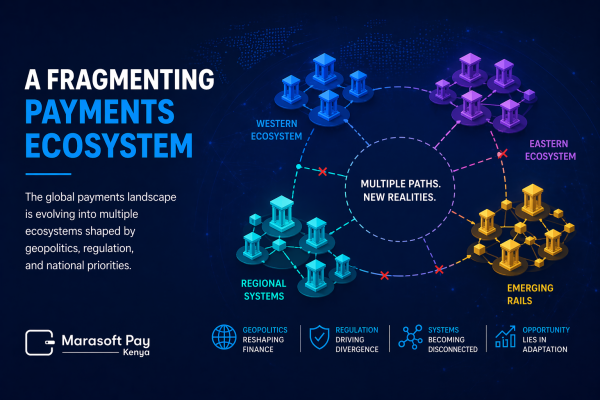
At the same time, the global response to these constraints is driving the emergence of alternative financial rails. Countries are actively investing in regional and domestic payment systems to reduce reliance on traditional correspondent banking networks and dominant currencies. This has led to a gradual fragmentation of the global payments landscape into distinct but overlapping ecosystems aligned along political and economic lines. While this fragmentation introduces complexity, it also signals a rebalancing of financial power, where access to infrastructure is no longer concentrated in a single global framework.
Africa’s response to this shift is particularly instructive. Initiatives such as the Pan-African Payment and Settlement System are designed to enable cross-border transactions in local currencies, addressing a long-standing inefficiency where intra-African trade has depended heavily on external clearing currencies. By reducing reliance on intermediaries and foreign exchange conversions, such systems have the potential to significantly lower transaction costs and improve liquidity across the continent. Given that intra-African trade still accounts for less than 20% of total trade volumes, compared to over 60% in Europe, the strategic importance of these payment innovations cannot be overstated.
Within this continental context, Kenya occupies a unique position. Its payments ecosystem, anchored by mobile money platforms such as M-Pesa, has already demonstrated how digital infrastructure can scale financial inclusion and transform domestic commerce. However, the next phase of growth is being shaped by external pressures as much as internal innovation. Currency volatility, global inflation trends, and tightening regulatory expectations—particularly around anti-money laundering and digital assets are all influenced by geopolitical developments beyond the region. Kenya’s ongoing efforts to introduce clearer regulatory frameworks for virtual asset service providers reflect a recognition that integration into the global financial system must be balanced with resilience against its risks.
What is emerging is a more complex operating environment for fintechs. Cross-border payments are no longer defined solely by speed and cost efficiency; they are increasingly shaped by jurisdictional risk, regulatory divergence, and access to financial infrastructure. This complexity is further amplified by the growing role of digital assets and blockchain-based settlement mechanisms, which are being explored globally as alternatives in environments where traditional rails are constrained or inefficient.
For fintech companies, particularly those operating in Africa, this moment demands a shift in perspective. Building for efficiency alone is no longer sufficient; systems must be designed for resilience, with the ability to adapt to rapidly changing regulatory and geopolitical conditions. Interoperability is also becoming a strategic priority, as the ability to connect multiple payment networks—both regional and global—will determine long-term competitiveness. At the same time, trust is being redefined. It is no longer derived solely from participation in established global systems, but from demonstrable compliance strength, transparency, and the capacity to operate seamlessly across diverse regulatory environments.
From a Marasoft perspective, these developments reinforce a broader view of the industry’s direction. The future of payments will not be dictated by a single dominant system, but by a network of interconnected platforms operating across regions, currencies, and regulatory frameworks. In such a world, the winners will be those who can navigate complexity without compromising reliability, and who can innovate while remaining firmly aligned with evolving global standards.
Geopolitical tensions, including those currently shaping global discourse, are not isolated disruptions. They are indicators of a longer-term transition toward a more fragmented, yet more dynamic financial system. For the fintech sector, and particularly for players in emerging markets, this transition presents both risk and opportunity. The ability to understand these forces and respond with deliberate, well-structured solutions will ultimately define leadership in the next era of payments.