
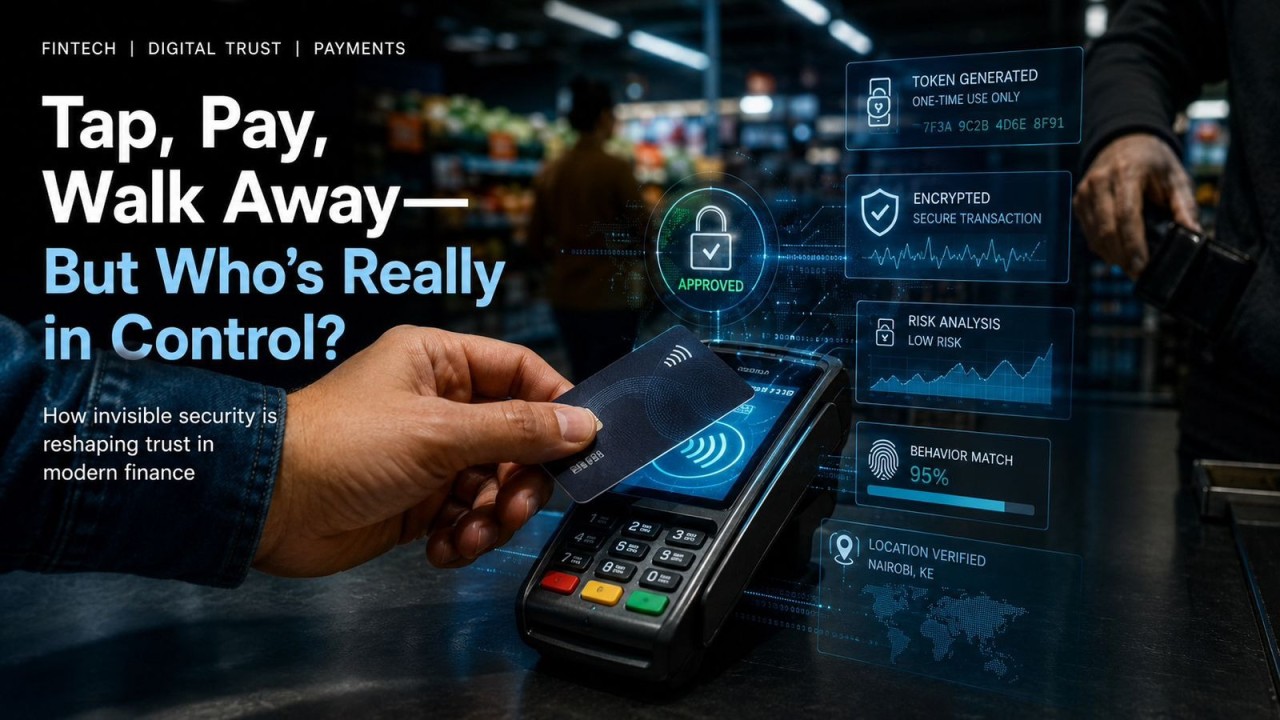
You walk into a supermarket, pick what you need, tap your card, and you’re done. No PIN. No signature. No friction. It feels effortless almost too effortless. And that’s where the question creeps in: if someone else had your card, could they do the same thing just as easily?
This is the reality of modern contactless payments, powered by technologies like near-field communication (NFC) and global standards such as EMV. What looks like a simple tap is actually a highly controlled exchange. Your card doesn’t expose your real details; instead, it generates a one-time encrypted code for each transaction. Even if intercepted, that code is useless. Behind the scenes, layers of security are working in milliseconds to confirm that the transaction is legitimate without interrupting your experience.
So why isn’t there a PIN? The answer lies in design trade-offs. Financial systems today are built around a balance between convenience and risk. For small transactions, banks allow payments to go through without additional verification, relying on spending limits and backend monitoring to manage potential fraud. The assumption is simple: the speed and ease of payment are worth the relatively low risk of small unauthorized transactions. It’s a quiet shift in how we think about security not as something visible, but as something embedded.
Still, the risk is not zero. If a card falls into the wrong hands, it can be used for multiple low-value purchases before being blocked. The system is secure by design, but not immune in practice. And this is where fintech begins to play a deeper role not just in enabling payments, but in redefining how trust is managed in financial systems.
In places like Nairobi, the story has taken a different path. Instead of cards, the foundation of digital payments was built on mobile money platforms like M-Pesa. Here, financial innovation prioritized access over convenience ensuring that people could send and receive money without needing a bank account at all. The result is a system that feels very different from contactless card payments, yet solves an equally important problem. While one ecosystem optimizes for speed at the checkout counter, the other optimizes for inclusion at a national scale.
What’s happening now is a quiet convergence. Card-based systems are becoming smarter, integrating biometric authentication, real-time fraud detection, and behavioral analytics. At the same time, mobile-first systems are expanding into richer financial services credit, savings, and global payments. Fintech sits at the center of this convergence, acting as both the enabler and the challenger. It pushes financial institutions to rethink old models while introducing entirely new ways of verifying identity and managing risk.
The real shift, however, is philosophical. Security is no longer about stopping transactions, it’s about understanding them. Instead of asking whether a payment is valid, modern systems are increasingly asking whether it makes sense. Does this transaction match your usual behavior? Is it happening in a familiar location? Does it look like something you would do? In this way, fintech is moving beyond passwords and PINs toward something more dynamic: trust based on patterns, not just proof.
That simple act; tap, pay, walk away captures the essence of where finance is heading. It is fast, invisible, and increasingly intelligent. But it also raises a deeper question about how much risk we are willing to accept in exchange for convenience. Because every seamless transaction is backed by a system making assumptions about you, your behavior, and your identity.
Fintech doesn’t just make payments easier. It reshapes the relationship between speed, security, and trust. And as these systems continue to evolve, the challenge will not be building faster ways to pay, but building smarter ways to know who is really paying.