
More mobile money accounts than people, and fewer places to cash out
Mobile money subscriptions grew 13.2% over the year to reach 54 million by June 2026 , which works out to 101.3% penetration. In other words, there are now technically more registered accounts than there are people in Kenya, though many people hold more than one. Safaricom’s M-Pesa accounts for
88.8% of that market, leaving Airtel, Telkom Kenya and newer entrants such as Finserve’s Equitel to share roughly a tenth. The more surprising figure sits underneath. According to the Communications Authority’s latest sector statistics, the number of registered mobile money agents fell 5.6% in a single quarter, from 602,470 to 568,463. Accounts are rising while the physical network is shrinking.
The likely explanation, as Techweez reads it, is consolidation among agents combined with more app-based transactions and merchant payments that don’t require a trip to a kiosk. That is an interpretation, not a proven cause, but it fits what businesses see day to day. More customers now expect to pay from their phone, wherever they are, and never touch cash. The same report points to how important this has become for the telecom industry itself. Mobile money sits inside a category that made up 42.8% of all mobile service revenue in 2025, more than voice or data individually. Financial services are no longer a side business on the network. They are the business.
The conversation around the payment just got a price tag
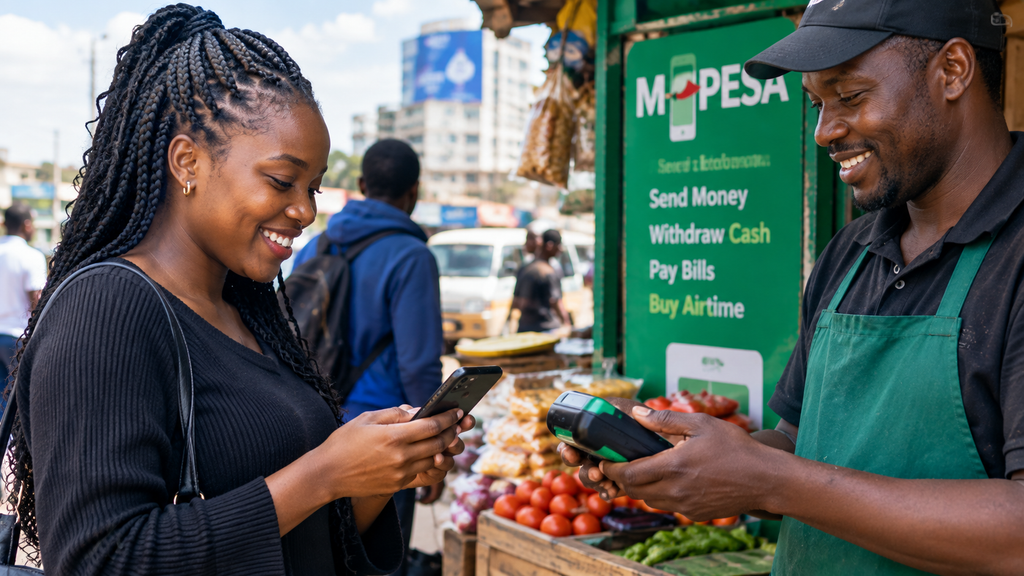
Payments rarely happen in isolation. A customer asks about a price, gets a reply, receives a payment request, pays, and expects a confirmation. For many Kenyan businesses, especially small ones, much of that exchange happens on WhatsApp.
From 1 October, Meta started charging for some WhatsApp Business messages that were previously free, according to Techweez’s report. The change applies to businesses using the WhatsApp Business Platform, the API that connects WhatsApp to CRMs, chatbots and contact-centre software. Service
messages, which are ordinary replies inside the 24-hour customer window, will become chargeable after a monthly allowance of 1,000 delivered messages per business phone number. Utility templates, the transactional notices such as order updates and payment alerts, will also be billable even when sent inside that window.
The reported Kenyan rate is about US$0.004, or roughly KES 0.52 per message. At that rate, a business delivering 100,000 service messages in a month would have around 99,000 chargeable ones, which works out to about KES 51,480 on Meta’s side before any provider fees or taxes. That is modest for a
large company and a real cost for a small one. Meta charges the business rather than the customer, and it’s worth noting that the standalone WhatsApp Business app is different from the API, so owners should check which one they use. The pricing details are on Meta’s developer pages.
The more interesting effect is on behaviour. What counts is the number of delivered messages, not the number of customers. A chatbot that answers with five short messages instead of one clear one now costs five times as much. Businesses have a new financial reason to look closely at how they design conversations.
What this means for how you take payments
Put the two stories together and a pattern appears. Customers are paying remotely on their phones, with fewer physical agents in between, and the channel businesses use to chat with them now costs money per message. That makes efficiency in the payment journey more valuable than it used to be.
A few practical implications follow. Every unnecessary back-and-forth between a sale and a payment is now a small cost as well as a small annoyance, so payment requests should be complete the first time, with the amount, the reference and the ways to pay in a single message. Payment confirmations should be automatic and reliable, because a customer who doesn’t see one will message you to ask, and that
message costs both of you time. And relying on cash-in and cash-out agents for your own cash flow looks less safe if the agent network keeps thinning, so accepting digital payments directly is more than a convenience.
None of this means moving away from M-Pesa. With an 88.8% share, it remains the payment method
most of your customers will reach for first. But the remaining 11.2% of mobile money users, plus card
and bank customers, still matter, especially for businesses that sell to more than one segment.
Where Marasoft Pay fits
This is the situation our payment links were designed for. A link can be shared over any messaging channel and lets the customer pay by mobile money, card or bank transfer, with a real-time notification to you when it lands. Combined with a single payment integration across M-Pesa, Airtel Money, T-Kash and cards, it reduces the number of messages it takes to turn an enquiry into a settled sale. Developers who want to build the flow into their own systems can start with our API documentation, and everyone else can request a demo or browse our FAQ.
Figures are drawn from Techweez’s reporting on the Communications Authority’s sector statistics and Meta’s pricing announcement. Check current rates with Meta and your provider before making decisions.